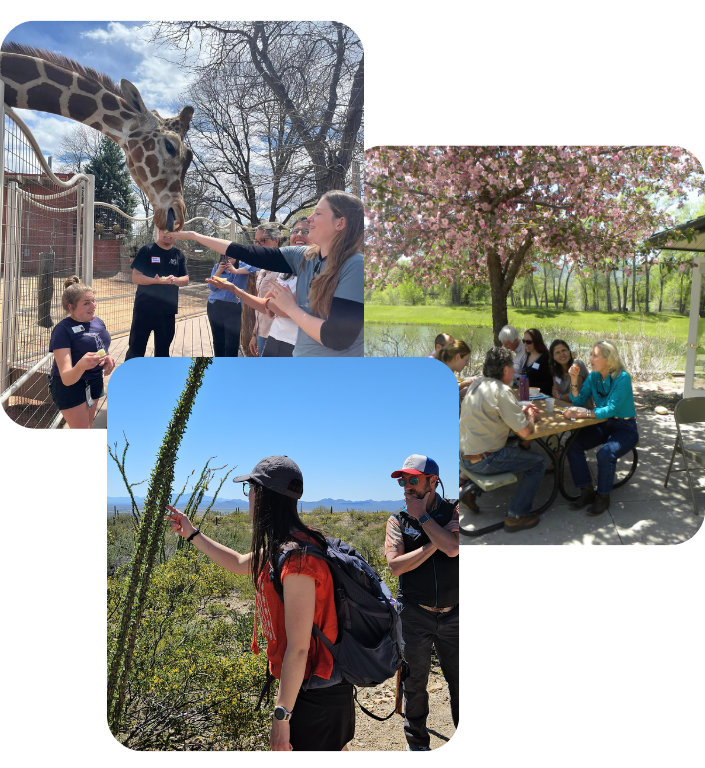
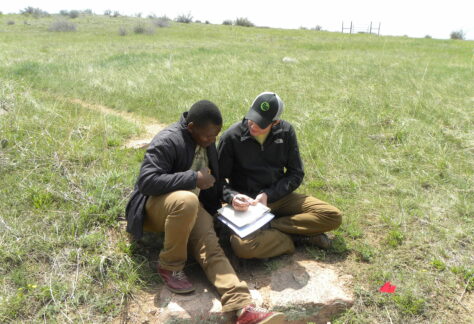
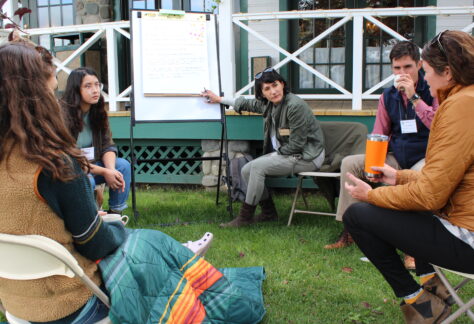
The purpose of the CCC Fellows Program is to strengthen engagement among students, faculty, conservation practitioners and other stakeholders by promoting collaborative research, education and action on critical issues concerning conservation and livelihoods on landscapes around the globe.
The CCC fellows are part of the new Collaborative Conservation Learning Network where principles and practice of collaborative conservation are developed, exchanged, tested and adapted.
The second cohort of CCC fellows will be working in 11 countries, including:
Of the seven fellows who will be working in the United States, five will be working in communities across Colorado from the Front Range to the Western Slope, one will be working with a rancher’s collaborative in Montana, and another with members of more than 30 tribal nations across the nation. The fellows also represent six departments and two colleges at CSU, and three non-governmental organizations doing conservation work in Colorado.
They are working on problems as diverse as the sharing of scarce water resources among agricultural and urban communities in Colorado, to conservation of the endangered Mongolian wild ass, to engagement of transboundary stakeholders in ecosystem services projects in Costa Rica and Panama. In Colorado, five fellows are working on better understanding how collaboratives work and how they can work effectively through using both market and non-market-based incentives for conservation.
|
R. Patrick Bixler
Patrick is a PhD student in the Department of Sociology, CSU, working with Dr. Pete Taylor. Through a fellowship partnership with the Blackfoot Challenge, a rancher-led collaborative initiative in Montana, Patrick will collaboratively explore the problem of transferability and scaling up of the Blackfoot Challenge experience. Specifically, he will ask: How does a community-based stewardship organization balance the desire to be place-based with the responsibilities of sharing the collaborative conservation message?
Click here to see Patrick's report on his fellowship.
|
| |
Brett Bruyere
Brett is an Assistant Professor in the Department of Human Dimensions of Natural Resources at CSU. His fellowship includes a combination of research and outreach/education in environmental science and communication in the Samburu region of Kenya. Specifically, he is collaborating with organizations engaged in similar work in other parts of Kenya to share best practices and lessons learned; integrate youth in citizen science to participate in monitoring of local conditions; include the involvement of faculty and/or students from Kenya Methodist University in conducting this research and outreach; and develop viable educational formats and activities to engage local youth and their communities in conservation.
Click here to see Brett's article about his fellowship.
|
| |
Gabriela Bucini
Gabriela recently received her PhD in the Graduate Degree Program in Ecology at CSU, working with Dr. Niall Hanan. During her CCC fellowship, Gabriela will transfer her knowledge in remote-sensing and GIS to local communities in Guinea Bissau, acquire the collaborative conservation skills necessary to support the use of spatial data in the dialogue on conservation and livelihood issues, and build links with Portuguese research scientists and conservation practitioners in Guinea Bissau that will develop into actions to conserve a national park in harmony with the livelihood needs of local inhabitants. |
![]() |
Tony Cheng
Tony is an Associate Professor in the Department of Forest, Rangeland and Watershed Stewardship at CSU. The purpose of his fellowship is to develop a systems analysis framework in collaboration with practitioners to examine and improve the interaction between localized collaborative forest stewardship conservation on U.S. public lands and multi-level organizational and policy systems. Click here to see Tony's discussion paper: What is ‘resilience’ and what does it look like for public land ecosystems and rural communities?
|
| |
Dieter Erdmann
Dieter is the Director of Conservation Operations for Colorado Open Lands, a statewide non-profit land trust. For Dieter’s fellowship, he is working to leverage private land conservation incentives with municipal investments to promote agricultural water sharing along the Lower South Platte River in Colorado to sustain agricultural communities while meeting the growing water demands of urban areas. Click here to see a powerpoint Dieter presented at a CCC seminar: Agricultural Water Transfers: Alternatives to Buy and Dry in Colorado's South Platte Basin.
Also see Dieter's Open Landscapes Newsletter article: South Platte Farmers Plant the Seed for Alternatives to Buy and Dry.
|
| |
Maria Fernandez-Gimenez
Maria is an Associate Professor in the Department of Forest, Rangeland and Watershed Stewardship at CSU. Her fellowship builds on existing collaboration with Mongolian research organizations and NGOs to build the capacity of Mongolian scientists and practitioners for applied interdisciplinary participatory research. It also launches a new collaboration with the Pyrenean Institute of Ecology (Spain) and villagers in four Pyrenean valleys, to study the effects of socio-economic change on pastoral communities and management institutions. Check out Maria's blog, "La Pastora de Jaca," here. Click here to view a photo book based on Maria's fellowship project in Mongolia.
Click here to read a High Country News interview with Maria.
|
![]() |
Angie Fuhrmann
Angie is a Master´s student in the International Development Studies program in the Department of Anthropology at CSU. Angie is working with five Shipibo indigenous communities in the central Peruvian Amazon and the nonprofit Village Earth to hold a collaborative capacity-building workshop to raise awareness about indigenous territorial issues in the district, introduce the different stakeholders to one another, and to teach community representatives GPS and compass technology so they have the technical capacity to carry out their own territorial demarcation. This is a collaborative step in decreasing illegal deforestation of the region and mitigating conflicts with illegal colonists that threaten both the environment and Shipibo culture.
|
![]() |
Art Goodtimes
Art is Chair of the San Miguel County, CO Board of Commissioners, chair of the Public Lands Steering Committee of Colorado Counties, Inc. (the state county government organization), a member of the board of the Western Interstate Region of the National Association of Counties (NACo) and also of a member of NACo's Public Lands Steering Committee and chair of NACo's Gateway Communities Subcommittee. The goal of his fellowship is to craft a county-run pilot project that will offer private ranches in the San Miguel River watershed a calculated revenue offset for ecosystem services that they are either currently providing or could provide in the future.
|
| |
Hill Grimmett
Hill is the Founder and Director of the Northern Colorado Food Incubator and Co-Director of Be Local Northern Colorado. During this fellowship, Hill is developing a marketing action plan for local “conservation beef.” In collaboration with a small number of local producers of grass-fed beef, he is exploring the opportunities for developing a branded line of beef products to be sold at the proposed Fort Collins Community Marketplace and elsewhere. In addition to his marketing action plan, Hill will produce written plan documents for CCC’s Collaborative Conservation Learning Network. |
![]() |
Heidi Huber-Stearns
Heidi is a Master’s student in the Department of Human Dimensions of Natural Resources at CSU working with Dr. Stu Cottrell and Dr. Josh Goldstein. For her fellowship she will interview people involved in existing successful payments for ecosystem services (PES) projects to gain a better understanding of how to engage buyers, and work collaboratively with government, NGOs, and other partners in a trans-boundary area between Costa Rica and Panama. Her project will generate a working paper describing the collaborative approach utilized, a report of project results for community partners, and the formation of a PES practitioner network. |
| |
Kathie Mattor
Kathie is a PhD student in the Department of Forest, Rangeland and Watershed Stewardship at CSU working with Dr. Tony Cheng. During her CCC fellowship, she will work with agency and community practitioners to develop an improved understanding of the factors influencing the adoption of stewardship contracting for national forests and associated use of collaboration, as well as identifying various outcomes occurring as a result of this relatively new management option. |
| |
Gregory Pierce
Gregory is a Master’s student in the International Development Studies program in the Department of Anthropology at CSU, working with Dr. Jeff Snodgrass. His fellowship will explore how ethnically Tibetan agro-pastoralists in the Tarap Valley of Dolpo, Nepal cognitively model the interconnections between their subsistence livelihoods and the hydrological regimes of the glaciers in the Kanjiroba Range and how those models are being adapted to changes resulting from increased warming in the Himalayas.
|
![]() |
Jason Ransom
Jason is a PhD student in the Graduate Degree Program in Ecology at CSU, working with Dr. Tom Hobbs. Through his fellowship, Jason is developing a novel ground-based population estimation method that integrates local communities into conservation initiatives for threatened and endangered ungulates in Mongolia. He will help build a sustainable network of Mongolian pastoralists who can contribute to population estimates and long-term monitoring of khulan and gazelle in the Great Gobi B Strictly Protected Area (SPA). |
![]() |
Carl Reeder
Carl is a Peace Corps Masters International student studying geographic information systems (GIS) and forest science in the Department of Forest, Rangeland and Watershed Stewardship at CSU, under the direction of Dr. Melinda Laituri. Through his fellowship, he will develop and distribute a GIS training website containing tutorials engineered to improve the conservation capabilities of universities and land management institutions in Ethiopia while serving as a Peace Corps Volunteer. |
![]() |
Lee Scharf
Lee is the owner of a Fort Collins business, Mesa LLC, Mediated Environmentally Sustainable Action. Her fellowship will identify prospective tribal professionals interested in using or leading collaborative efforts to address conservation issues on tribal lands. Identification of interested tribal professionals will be done by in-person visits to tribal lands and to organizations engaged in tribal work, as well as by teleconference. A select group of tribal professionals will be asked to design a training to develop their practice expertise from tribal nation to tribal nation and with multiple stakeholders, through an online dialogue created by a CSU Native American student. Lee will contribute an article or report for the collaborative conservation learning network that describes the process and outcomes of her project.
|
|
Faith Sternlieb
Faith is a PhD student in the Department of Geosciences at CSU working with Dr. Melinda Laituri. Her fellowship will identify and map geospatial attributes that characterize institutional boundaries at different scales for the provision of water resources for livelihoods, livestock, and wildlife. The aim is to demonstrate innovative ways that will encourage collaborative governance in the Mara River Basin, a trans-boundary watershed in Kenya and Tanzania. As part of her fellowship, she traveled to the basin in June of 2010 and met stakeholders, identified communities and study sites, and consolidated relationships with partners. |
|
|
Nick Clarke, Intern |
|
![]() |
Jonathan Fanning, Intern |
![]() |
Adam Miller, Intern Adam is a sophomore majoring in Fish, Wildlife and Conservation Biology working as an undergraduate intern for CCC Heidi Huber-Stearns. Adam first interned with Esther Duke (first cohort), assisting with data entry and information management duties on her project linking conservation and farmer livelihoods through payments for ecosystem services in Western Panama. He will continue work on this project with Heidi. He will travel to Panama with Esther and Heidi in Fall 2010 in order to share project results and meet about his developing Panamanian Coffee Exchange concept. |